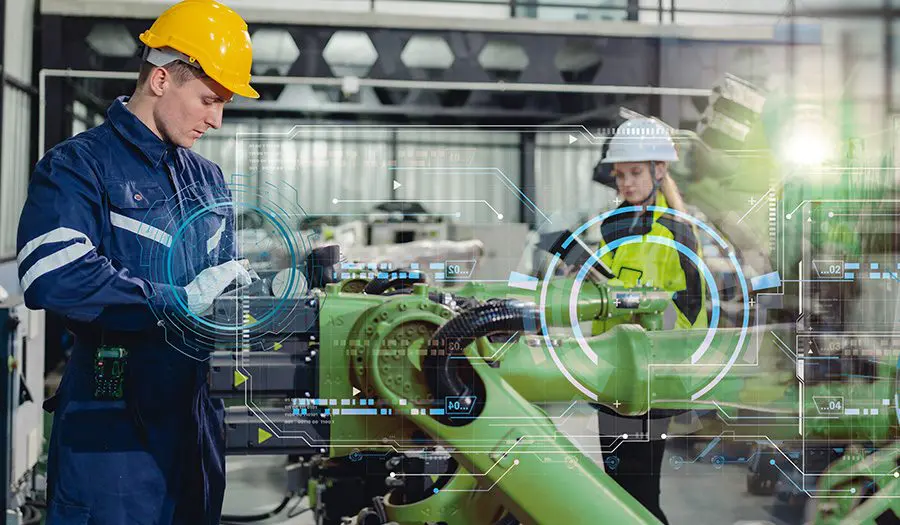
Automate Critical Tasks with Customized Robotic Installations
We design, integrate, and program robotic cells for welding, adhesive application, handling, and more, tailored to your processes and production needs.
What Solutions Does this Technology Include?
At Geprom, we integrate industrial and collaborative robotic solutions, adapted to each process, environment, and level of automation.
Our systems are applied in sectors such as automotive, food, metal, consumer goods, and pharmaceuticals:

Welding Robots
Automation of spot, arc, laser, or plasma welding, with maximum precision and repeatability.

Robots for Applying Adhesives, Sealants, and Mastics
Integration of dispensing systems for structural sealing, joining parts, or applying viscous materials and PVCs.

Handling Robots
For assembly operations, machinery feeding, parts transfer, or pick & place tasks.

Robots for Loading and Unloading
Automation of repetitive processes in production lines, improving performance and operational safety.

Robots for Palletizing and Depalletizing
Solutions for handling boxes, sacks, trays, or finished products, optimizing the end of the line.

Robots for Painting and Coatings
Uniform application of paint, varnishes, or sealants with precise control of trajectory, thickness, and finish.

Turnkey Robotic Cells
Complete stations that combine robotics, artificial vision, sensors, and safety systems for complex tasks.

Collaborative Robots (Cobots)
Flexible automation for operations shared with operators, without the need for fencing, with maximum ergonomics and safety.
What Problems Does this Solution Solve?
Low Efficiency in Repetitive Processes
Robots work continuously, without pauses or fatigue, increasing productivity and reducing cycle times.
Human Errors and Variability in Quality
Automation guarantees precision, repeatability, and constant control, improving the quality of the final product.
Dangerous or Non-Ergonomic Working Conditions
Robots take on tasks that involve physical risks (high temperatures, repetitive strain, exposure to chemicals), improving workplace safety.
Difficulty Covering Repetitive Operational Positions
In an environment with a shortage of qualified labor, robotics allows maintaining production without depending on rotations or absences.
Need for Flexibility in Production Lines
Robots, especially collaborative ones, allow adapting to different products or format changes without the need for major modifications.
High Costs Due to Rework or Unplanned Shutdowns
Automation reduces defects and improves traceability, which translates into less waste and greater line availability.
Benefits for your Company/Industry/Plant
-
Increased productivity
Robots allow working 24/7 with fast and constant cycles, which increases total production without the need to extend shifts.
-
Improved quality and reduction of errors
Deviations and variations typical of manual work are eliminated, guaranteeing homogeneous results and high-quality products.
-
Reduction of operating costs
By reducing rework, line stops, and dependence on intensive labor, the cost per unit produced is optimized.
-
Greater workplace safety
Dangerous or repetitive tasks for operators are eliminated, reducing the risk of accidents and work-related injuries.
-
Adaptability and productive flexibility
Especially with cobots and reconfigurable stations, you can quickly adapt to new products, formats, or smaller batches.
-
Industrial scalability
Automation allows you to scale production without compromising quality or overloading personnel.
-
Traceability and process control
By integrating sensors, artificial vision, and data systems, you obtain real-time information to improve decision-making.
-
Technological image and innovation
Showing a robotized plant improves the perception of customers, investors, and potential talent, positioning you as a modern and innovative company
Automate your plant with intelligent robotic solutions
Talk to an expertUse Cases
At Geprom, we implement robotic solutions in real industrial environments, adapted to the challenges of each sector. These are some application examples:

Automotive
- Welding of structural components
- Application of adhesives and mastics to car bodies
- Handling of parts in assembly lines
- Palletizing of components and subassemblies

Food and Beverages
- Packaging, labeling, and palletizing of products
- Handling of containers and raw materials
- Cobots for visual inspection and collaborative tasks

Metal and Capital Goods
- Loading and unloading of CNC machines
- Handling of heavy metal parts
- Application of paint and coatings

Pharmaceutical
- Precise dosing and handling in clean rooms
- Palletizing of batches and feeding of lines
- Cobots for repetitive operations with operators

Logistics and Packaging
- Automatic palletizing and depalletizing
- Classification and handling of boxes and trays
- Integration with vision and traceability systems
Success Stories




Our Clients








What our Clients Say
-
“This project is a commitment to innovation that will allow us to evolve our business and thus guarantee the authenticity and quality of our tobacco. With Telefónica Tech’s traceability solution, we comply with European regulations on tobacco products and achieve comprehensive control and monitoring.”
-
“The digital transformation project that we are starting aims to improve each and every one of the company’s processes, adapting to the new technological environments to achieve the highest level of effectiveness and efficiency at the Fini Company”
-
“Measuring, controlling, and reducing the costs of bottling and storage processes is our challenge in a highly competitive environment with companies in the sector and declining consumption in all markets. Decisions regarding both processes, along with those related to quality, must be precise to offer the best service, and thus differentiate ourselves from our competitors.”
-
“The IoT4DigitalTwin project, developed in consortium with Geprom and Gefasoft, has allowed us to incorporate the most advanced technologies of Industry 4.0, is bearing fruit, and represents an advance in boosting our competitiveness and efficiency.”
-
“With the collaboration of Geprom and its GeTag platform, we have boosted the efficiency of our processes by centralizing business information and improving the customer service we offer.”
-
“Through the technology consulting sessions, they outlined the implementation of Industry 4.0, indicating not only the areas for improvement that we were seeking, but also other improvements that will help us enhance our production and our work system.”
-
“Proactively deploying a pilot test of the MES Objective system allowed us to verify the reduction of unnecessary costs to a minimum and allowed us to assess the investment in detail.”
-
“Objective’s technical support service demonstrates its excellent knowledge time and again, available 24 hours a day”
-
“In MES, master data can be fantastically integrated with production lines to eliminate paper on the factory floor. Furthermore, always having the correct data available is a necessity in our sector.”
-
“The collaboration with Objective is very pleasant. The combination of Objective’s technical solution and Modiform’s experience has led to new ideas and developments that we now see again in the new version of Objective.”
Methodology
How Do We Work?
Process Analysis and Technical Feasibility
Initial study of requirements and definition of project objectives.
Robotic Simulation and Technology Selection
Virtual validation of the workflow and choice of the most suitable solution.
Cell Design or Integration into Existing Line
Detailed engineering adapted to the client’s plant and processes.
Programming and Start-Up
Configuration, testing, and validation in a real production environment.
Operator Training and Maintenance
Team training and continuous support to guarantee efficiency.
Get your Questions Answered
Frequently Asked Questions
Yes. We integrate robots into your existing digital infrastructure.
Yes. Automation can be partial and scaled according to needs.
It depends on the type of task, environment, payload, and objectives. We will analyze it with you.
Still Have Questions?
Still have questions? Contact us and our team will be happy to help.