SCM – Production Planning Software
Total control and visibility to make better logistics decisions.
What is SCM Software and What is it for?
SCM (Supply Chain Management) tools allow for the comprehensive management of the supply chain, preventing stockouts and delays that affect production and deliveries.
Our solutions create transparency throughout the logistics network through the efficient organization of resources, purchase planning, and workload allocation.
Thanks to its ability to adapt to different industries and its integration with ERP systems, SCM tools offer strategic support in decision-making for companies of all sizes.
Main Functionalities
Demand Prioritization and Forecasting
Allows you to anticipate market needs, adjusting supplies and logistics capabilities.
Cross-planning SCM for one Plant or Several Production Centers
Coordinates production and logistics between different locations, avoiding duplication and ensuring overall efficiency.
Planning of Activities and Subcontracting of External Suppliers
Manages purchases and tasks delegated to third parties, with visibility on dates, costs, and availability.
Inventory Optimizer Based on Demand
Balances inventory to avoid shortages or overstock, aligning available stock with real forecasts.
Supply Management (Extended MRP)
Launches purchase orders and automatic supply according to production needs and defined lead times.
End-to-end Supply Chain Visibility
Traceability from raw materials to final delivery, with alerts and order tracking.
Collaboration with Suppliers on Shared Platforms
Sharing of key information such as forecasts, needs, deliveries, and schedule changes.
Logistics Capacity Management
Planning and allocation of transportation, warehouse, and distribution resources.
Analysis of Logistics Costs and Simulation of “What-If” Scenarios
To evaluate the economic impact of changes in routes, volumes, suppliers, or production locations.
Connection with ERP and WMS Systems
Total integration to synchronize purchase data, inventories, logistics locations, and order statuses.
Benefits of SCM Software
-
Greater agility and speed of reaction to changes in the supply chain
-
Improved compliance with customer delivery deadlines
-
Efficient management in multi-plant environments and complex logistics networks
-
Inventory optimization based on demand
-
Integration with suppliers and subcontractors
-
Compatibility with the main ERPs on the market
-
No risk of integrations
-
Supply and purchase planning adjusted to the master plan
-
Greater visibility and control over the entire supply chain
Anticipate demand and improve your deliveries with intelligent SCM
Talk to an expertUse Cases

Distributed Supply Chain
Coordinate multiple plants or work centers, ensuring the synchronized flow of materials and products between them.

Management of Suppliers and Subcontracting
Plan external activities, aligning third-party deliveries with internal production needs.

Demand Forecasting and Aggregate Planning
Adjust plans based on sales forecasts and market trends, balancing capacity and inventory.

Inventory Optimization
Reduces overstock and shortages through planning aligned with real demand and supply times.

Supply Planning
Launches purchase or supply needs with sufficient anticipation, according to expected consumption and supplier lead time.
Related Solutions and Services
MES – Manufacturing Execution System
Geprom’s MES is designed to act as the central hub of industrial operations, integrating with automation (SCADA, PLC), business (ERP), and support (quality, maintenance, logistics) systems. Its modular architecture allows for flexible scaling, from data capture to complete traceability.
- Native integration with SCADA/DCS for real-time data capture
- Connection with ERP for orders, stocks, and reporting
- Interoperability with quality, traceability, CMMS, and WMS modules
- Validation in SAP, Microsoft, SAGE, etc. environments
- Multi-site and multi-plant architecture

Energy Efficiency Software
Integration with CMMS, MES, SCADA, and electrical devices
Connected, supervised, and optimized energy in real time
Geprom’s energy efficiency software integrates with the rest of the plant architecture to provide a complete view of consumption. It connects with SCADA to acquire electrical data, with CMMS to optimize maintenance, and with MES to correlate consumption with productivity.
- Captures data from SCADA and electrical sensors
- Crosses energy consumption with OEE, batches, or shifts via MES
- Integration with CMMS for predictive energy maintenance
- Compatible with ISO audits and industrial energy regulations

APS – Advanced Planning and Scheduling
Integration with other systems (ERP, MES, SCADA, QMS, WMS)
Global vision and optimized production scheduling
Geprom’s APS system allows you to plan and sequence manufacturing orders considering the actual plant capacity and the restrictions of materials, machines, and personnel. Its integration with ERP, MES, and other industrial systems ensures dynamic, accurate planning aligned with the operation.
- Bidirectional connection with ERP (SAP, Dynamics, Oracle, SAGE, etc.)
- Real-time synchronization with MES for production execution
- Simulation of productive digital twin type scenarios
- Flexible programming in multiline and multiplant environments
- Resource optimization and bottleneck reduction

SCADA – Supervisory Control and Data Acquisition
Integration with PLC, MES, DCS and ERP
Total supervision and base for industrial digitization
Geprom’s SCADA system connects with plant devices (PLCs, sensors, actuators) and feeds data to systems such as MES or ERP. It is the basis of real-time supervision and a key pillar for the deployment of MOM architectures.
- Direct communication with PLCs and DCS
- Synchronization with MES for recipe control, alarms, and OEE
- Export of historical data to ERP or BI
- Flexibility to connect to existing sensors, HMI interfaces, and control systems

WMS – Warehouse Management System
Integration with ERP, MES, and IoT devices
Logistics and production synchronized in real time
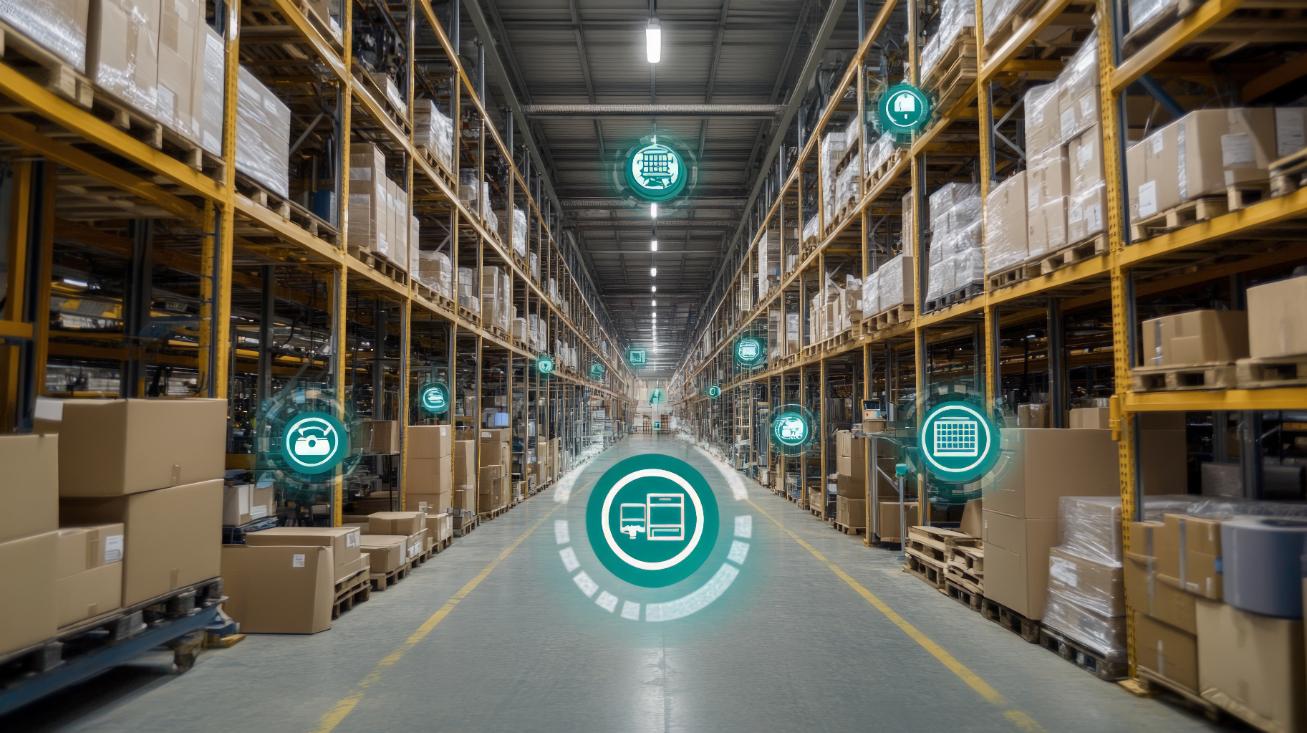
Geprom’s WMS system integrates with the ERP to manage orders, stocks, and work orders, and with the MES to coordinate inputs, consumption, and returns. In addition, it connects with sensors, RFID tags, and logistics automation technologies (robots, AGVs, automatic shelving).
- Connection with MES for operational traceability and production orders
- Integration with ERP for logistics and finance
- Interoperability with RFID, barcodes, NFC, AGVs
- Advanced management of picking, returns, cross-docking
- Total logistics visibility from plant to dispatch
CMMS – Computerized Maintenance Management System
Integration with MES, ERP, WMS and IoT devices
Connected maintenance for a more efficient factory
Geprom’s GeTag CMMS software integrates in real time with MES, WMS and ERP to consolidate all information related to assets, maintenance, parts and resources. Its open architecture allows the incorporation of predictive maintenance technologies and advanced analytics.
- Connection with ERP for purchases, stocks, costs and planning
- Integration with MES for planning productive maintenance
- Synchronization with WMS for parts, technical warehouse and spare parts
- Connectivity with sensors, IoT, NFC/RFID tags
- Prepared for predictive maintenance and advanced analytics

QMS – Advanced Quality Management Software
Integration with MES, ERP, and inspection systems
Connected quality control and total traceability
QMS connects with MES and ERP to ensure a continuous flow of data between production, quality, and business. In addition, it integrates with LIMS systems, measuring devices, and artificial vision, capturing key parameters in real time to ensure product and process conformity.
- Direct interface with MES to activate automatic controls
- Synchronization with ERP for document and batch management
- Integration with sensors, scales, artificial vision, SCADA
- Compatible with ISO, FDA 21 CFR Part 11 standards
- Connectivity with laboratory systems (LIMS)

Industrial Control Tower
Integration with all MOM, ERP, IoT systems, and BI platforms
Centralized command center for global decision-making
Geprom’s industrial control tower collects data from MES, SCADA, ERP, and IoT sensors to provide a unified view of the entire factory or group of plants. It is the top layer of operational intelligence, ideal for multi-plant environments and distributed processes.
- Integration with MES, SCADA, ERP, IoT, sensors, and external devices
- Creation of personalized dashboards, accessible from any device
- Real-time decision-making based on cross-referenced data
- Global orchestration of processes, plants, and systems
- Automation of decisions based on operational rules

Success Stories







Our Clients


















What our Clients Say
-
“This project is a commitment to innovation that will allow us to evolve our business and thus guarantee the authenticity and quality of our tobacco. With Telefónica Tech’s traceability solution, we comply with European regulations on tobacco products and achieve comprehensive control and monitoring.”
-
“The digital transformation project that we are starting aims to improve each and every one of the company’s processes, adapting to the new technological environments to achieve the highest level of effectiveness and efficiency at the Fini Company”
-
“Measuring, controlling, and reducing the costs of bottling and storage processes is our challenge in a highly competitive environment with companies in the sector and declining consumption in all markets. Decisions regarding both processes, along with those related to quality, must be precise to offer the best service, and thus differentiate ourselves from our competitors.”
-
“The IoT4DigitalTwin project, developed in consortium with Geprom and Gefasoft, has allowed us to incorporate the most advanced technologies of Industry 4.0, is bearing fruit, and represents an advance in boosting our competitiveness and efficiency.”
-
“With the collaboration of Geprom and its GeTag platform, we have boosted the efficiency of our processes by centralizing business information and improving the customer service we offer.”
-
“Through the technology consulting sessions, they outlined the implementation of Industry 4.0, indicating not only the areas for improvement that we were seeking, but also other improvements that will help us enhance our production and our work system.”
-
“Proactively deploying a pilot test of the MES Objective system allowed us to verify the reduction of unnecessary costs to a minimum and allowed us to assess the investment in detail.”
-
“Objective’s technical support service demonstrates its excellent knowledge time and again, available 24 hours a day”
-
“In MES, master data can be fantastically integrated with production lines to eliminate paper on the factory floor. Furthermore, always having the correct data available is a necessity in our sector.”
-
“The collaboration with Objective is very pleasant. The combination of Objective’s technical solution and Modiform’s experience has led to new ideas and developments that we now see again in the new version of Objective.”
our Partners




The Digital Maturity Pyramid
What Level of Digital Maturity Does this Product Cover?
Level 3 · Production Management (MES) with a global view of the chain
Our SCM is oriented to Level 3 of the digital maturity pyramid (ISA‑95): it integrates real-time data and synchronizes planning, purchasing, inventory and logistics with production. The result is end-to-end traceability, total control of supply and demand and rapid replanning in the face of changes.
In addition, it prepares the leap to Level 4 (MOM) by connecting with ERP, MES and WMS, aligning all operational areas under the same master plan.
Get your Questions Answered
Frequently Asked Questions
Forecasting models and historical analysis are incorporated to adjust purchases and production to expected demand, reducing inventory excesses and increasing accuracy.
The SCM incorporates suppliers into the digital chain, sharing production plans, purchase forecasts, and delivery needs for better synchronization.
It allows for distributing the load between locations according to their available capacity, delivery times, or local stock. It increases agility and makes better use of global resources.
An SCM system allows for the alignment of production, purchasing, warehousing, and logistics around actual demand. This reduces costs, prevents stockouts, and improves customer service.
Still Have Questions?
Still have questions? Contact us and our team will be happy to help.
You might be Interested In

What is Advanced Planning Software (APS)?
27 de February de 2025

Production planning software (PSA) in the MOM environment
18 de November de 2022

What is Production Planning?
19 de May de 2021