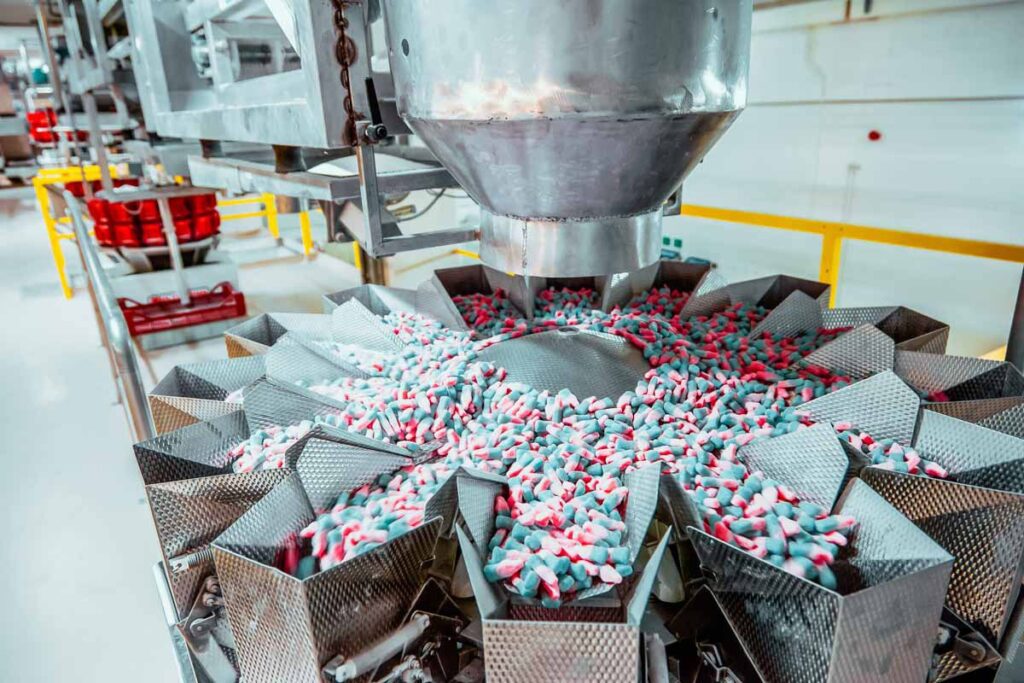
Production planning is based on setting up a work plan based on received orders or expected sales. Thanks to production planning, a company can organize its production processes logically and efficiently.
Every manufacturer wants to produce optimally and profitably. An important element within the MES OBJECTIVE that can ensure this is production scheduling and control. With this functionality, it is possible to plan production orders on production lines at specific times and also track all progress in real time.
Production planning, scheduling, and control give the freedom to determine the sequence of orders. Thus, the plan is represented in a graphical table that adapts to manufacturing and customer needs.

Production Planning Advantages
Production capacity planning allows for improved efficiency and profitability in your production process. Additionally, it also has the following advantages:
Classification and Scheduling:
It’s possible to schedule orders based on arrival time or when they need to be ready, thanks to the production planning, scheduling, and control capacity. After planning, there’s the possibility to make additional optimizations. Production Organization Example:
Classification by color of a product. For a candy manufacturer, it’s important that white candies are not made after colored ones, as the color and quality might be affected. However, when this happens, a lot of time is wasted because the entire line has to be cleaned. Additionally, there may be residues from previous orders. To avoid these issues, this can be visualized in the Objective planning table. It can be configured and linked to a specific attribute. Blocks with the same colors can be scheduled consecutively, ensuring optimal time use while ensuring quality.
Real-time Overview
Real-time data is an important concept in the food and beverage industry. With production planning and organization, it is possible to maintain a real-time overview of the production progress and track the status of production orders in real-time. Production Planning Example:
We need a specific mold to make certain candies, and there is only one mold available. For this specific mold, two production orders are required. On the Objective planning board, this is easily visualized, and it’s clear that these two orders cannot be carried out simultaneously.
Optimal Use of Production Lines:
Thanks to production capacity planning, you can get a clear view of which production orders can be done simultaneously, ensuring that products will be made at the right times. With proper planning and organization, the sequence is determined in advance, so operators don’t have to worry about what needs to be done first. This ensures optimal use of the lines. Thanks to the high-quality planning mechanism and graphical interface, it is possible to schedule days/shifts in a way that lines are used 100% without wasting time. This ensures optimal use of available production time.
Production Planning: Special Orders
EProduction planning software also allows for scheduling and controlling some special or differentiated types of orders, such as:
Gluten-Free, Lactose-Free, and Kosher Products:
Many manufacturers face special order requests, such as making gluten-free, lactose-free, or kosher products. Similar products can be scheduled on the same production lines. Whether it’s kosher, gluten-free, or lactose-free products, these parameters can be introduced into an item’s settings. These parameters are clearly and visually communicated to the operator on their control screens. This way, the planner can ensure that, for example, no gluten-free order is scheduled after a gluten-containing one. This guarantees that no gluten residue remains in the line, ensuring that all special production orders are made under the right conditions.
Last-Minute Orders:
Within the Objective software, it’s possible to respond to last-minute orders. This is done through an urgent order that arrives via an ERP system. This order may take priority over already scheduled orders. While production planning allows a regular order to be manually prioritized in the graphical scheduling table, it’s automatically done in the case of an urgent order. As long as an order hasn’t started yet, another order can be put into production.
Production Scheduling and Control
Production planning can be optimized through production scheduling. Let us explain the process below.
A manufacturing order may consist of several steps. The entire production process is optimized by linking the different steps of a production order.
For example, when producing a salad with mixed carrots: washing lettuce, cutting lettuce, grating carrots, cutting carrots, and finally mixing everything in a jar. These tasks are done on three different production lines. The process is optimized because all these steps are interconnected. When the last step (mixing in the jar) is moved to another time in the program, the previous steps are also moved. Everything is interconnected.
Production Planning Methods
For advanced planning and production scheduling, Geprom | Part of Telefónica Tech offers the APS / SCM Software.
ORSOFT is the APS / SCM software for advanced production planning and sequencing. From planning and managing production and tracking operations to real-time work order management.